
DFM review
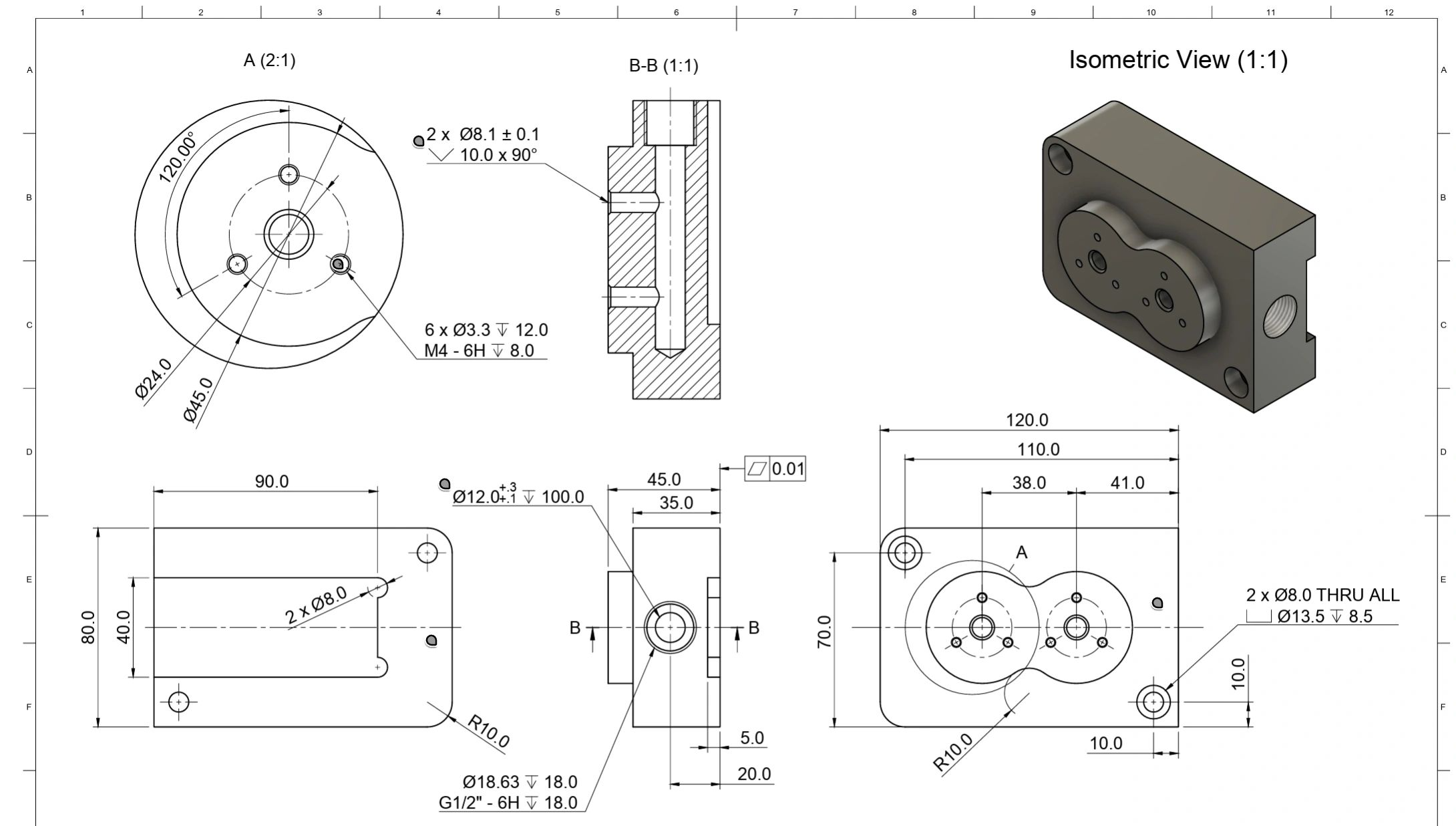
- Geometry & tool access
- Internal corners & radii
- Deep features & thin walls
- Assembly fit
Engineering support
Support from the engineers who will actually machine your part. The written DFM review is free, follows your order within 1–3 days, and comes before machining begins.
What this is
No guessing. No lost in translation.
Anything unclear on your print is confirmed with you by email during production. We don't pick the easiest interpretation.
What we review
The checklist
| Check | What we look at | Why it saves you money |
|---|---|---|
| Machinability and material fit | Is the specified material right for the job, and is there a cheaper grade that meets the same requirement | Material drives both stock cost and cycle time |
| Tool access | Can a cutter physically reach every feature, and in how many setups | Unreachable features force special tooling or a redesign |
| Internal corner radii | Inside corners sized to standard tool radii, or given a corner relief | A dead-sharp internal corner forces slow, costly EDM |
| Wall thickness | Thin walls and tall unsupported features | Below about 0.5 mm in metal, walls chatter and distort |
| Hole depth | Depth-to-diameter ratios beyond about 4 to 6× | Deep holes deflect tools and trap chips |
| Thread specs | Standard sizes and classes, thread depth, bottoming threads | Non-standard threads add tooling cost and lead time |
| Chamfers near walls | A chamfer running into a shoulder cannot reach the edge; the cutter needs back-out clearance | We flag the small un-chamfered stub before you find it on a first article |
| Tolerance realism | Which dimensions are truly critical, and which can relax to ISO 2768-m | You pay only for the strict tolerances the part actually needs |
| Finish callouts and dimension growth | Anodise and plating thickness against toleranced dimensions | Hard anodise grows a dimension; we confirm fits still work after finishing |
In practice
Material guidance
A pattern we see often: stainless steel specified on a part that carries no structural load, usually for the look or out of habit.
Tip: tolerances
Representative example; actual savings depend on the part, material and quantity.
More than DFM
A welded frame often hides several simple machined parts. Where it helps, we advise on splitting a weldment into components that machine economically and bolt or pin together. Flatness and batch consistency usually improve along with the price.
We recommend the process the geometry wants: prismatic parts to milling, rotational parts to turning, long small-diameter parts to Swiss-style turning, and sharp internal corners or hardened features to EDM. When a small design change moves your part to a cheaper process, we say so.
Quantity changes the right answer. For prototypes we deliberately start extra blanks, so a single scrapped part never resets your lead time. For production we show you the price breaks at quantities like 10, 100 and 500, so you can pick the band where the unit economics work. Asking for a quantity ladder with your quote costs nothing.
The process
STEP, IGES, X_T, SLDPRT or 2D PDF, by email or the quote form. Want an NDA first? Ask, and we sign first.
A production engineer plans how to make your part on our machines and tooling. Anything unclear on your print is confirmed with you by email during production.
Within 1–3 days of your order, any saving or risk we see is written up in plain language: what to change, why, and roughly what it saves.
We never change geometry on our own. Most suggestions are minor and need no re-quote; we re-quote only when a change is significant. Decline and we machine exactly what your drawing says. A part that truly cannot be made is usually flagged before you order.
Mini-FAQ
It is free, and it does not hold up your quote: the quote comes first, and the written DFM review follows within 1–3 days of your order, before machining begins.
STEP and IGES are ideal. We also open X_T (Parasolid) and SLDPRT natively, and we can quote from a fully dimensioned 2D PDF alone. The fastest path to an accurate quote is a 3D model plus a PDF marking the critical tolerances.
Never. DFM suggestions are exactly that, suggestions. Every proposed change comes back in writing with its cost impact, and nothing is machined until you approve the revision or tell us to build to the original.
Often, yes. Welded fabrication itself is outside our process, but many weldments split naturally into machined components that bolt or pin together. Send the model and we will tell you whether a machinable split makes sense, at no charge.
Get started
Send your drawings for a quote within 48 hours, no obligation. The free DFM review follows within 1–3 days of your order.
NDA on request, signed before you share files.